Short courses are not the problem. Poorly designed short courses are.
In fact, short courses can be one of the best ways to build skills quickly. They are flexible, practical, and easier to fit into a busy schedule. For many businesses, that makes them a smart choice.
So why do some short courses fall flat?
Usually, it is not because the course is short. It is because the course is too generic, too rushed, or too far removed from real work. When that happens, people may enjoy the session, but little changes afterwards.
Here are five common reasons why some short courses fail — and what better training looks like.
1. They are too generic
A short course should feel relevant from the start.
Too often, training sessions are designed to suit everyone. It covers broad ideas, general advice, and common examples. On paper, that sounds safe. In practice, it can make the course feel vague.
People learn best when the content connects to their role, their team, and their day-to-day challenges. A sales team has different needs from a customer service team. A new manager needs something different from a senior leader.
When a course tries to speak to everyone, it often speaks to no one.
That is why tailored training matters. The more relevant the course feels, the more likely people are to stay engaged and use what they learn.
2. They are not linked to a real business goal
A short course should do more than fill a calendar slot.
Before any training starts, there should be a clear reason for it. What needs to improve? What problem is the course trying to solve? What should people do better once the session is over?
If those questions are not clear, the course can become a box-ticking exercise. People attend, take notes, and move on. The business then struggles to see any real value.
Good training starts with a clear goal. That could be improving communication, building leadership confidence, strengthening negotiation skills, or helping teams work better together.
When the goal is clear, the course has direction. It also becomes much easier to measure success.
3. They try to cover too much
This is one of the biggest mistakes in short-course design.
Some courses try to pack in too much content in too little time. They include too many models, too many ideas, and too many slides. The trainer may be knowledgeable, but the learners leave with full notebooks and no clear takeaway.
More content does not always mean more value.
In many cases, a focused short course is much more effective than a busy one. It is better to help people learn a few useful things well than to rush through everything at once.
A strong short course should leave people with practical tools they can remember and use. It should create confidence, not confusion.
4. There is no follow-through after the session
A course can feel successful on the day and still fail afterwards.
This happens when the learning ends the moment the session ends. People return to work, get busy, and fall back into old habits. Without support, even useful ideas can disappear very quickly.
Real learning takes place outside the training room. People need time to practise, reflect, and apply what they have learned. In many cases, they also need support from their manager or team.
That does not mean every short course needs a long programme attached to it. But it does mean there should be some kind of follow-through. That could be action points, coaching, practical tasks, or a short refresher session.
The best short courses do not just inspire people for a few hours. They help them make lasting changes.
5. They ignore the learner’s real environment
Training should make sense in the real world, not just in theory.
A course may be well designed, but it can still miss the mark if it does not reflect the learner’s working environment. Industry pressures, team culture, business expectations, and regional context all matter.
This is especially important in a diverse and fast-moving market. What works in one country or company may not work in another. For courses to be effective, they should consider the following:
- Examples need to feel familiar.
- Case studies need to feel realistic.
- The language and style need to suit the audience in the room.
When training feels disconnected from real life, learners are less likely to trust it or use it.
When it feels relevant, practical, and grounded in their world, the impact is much stronger. This is why customisable training is so important.
Short courses benefits
There are many myths surrounding short courses. Some think they are not recognised, ineffective, or they don’t deliver actual results.
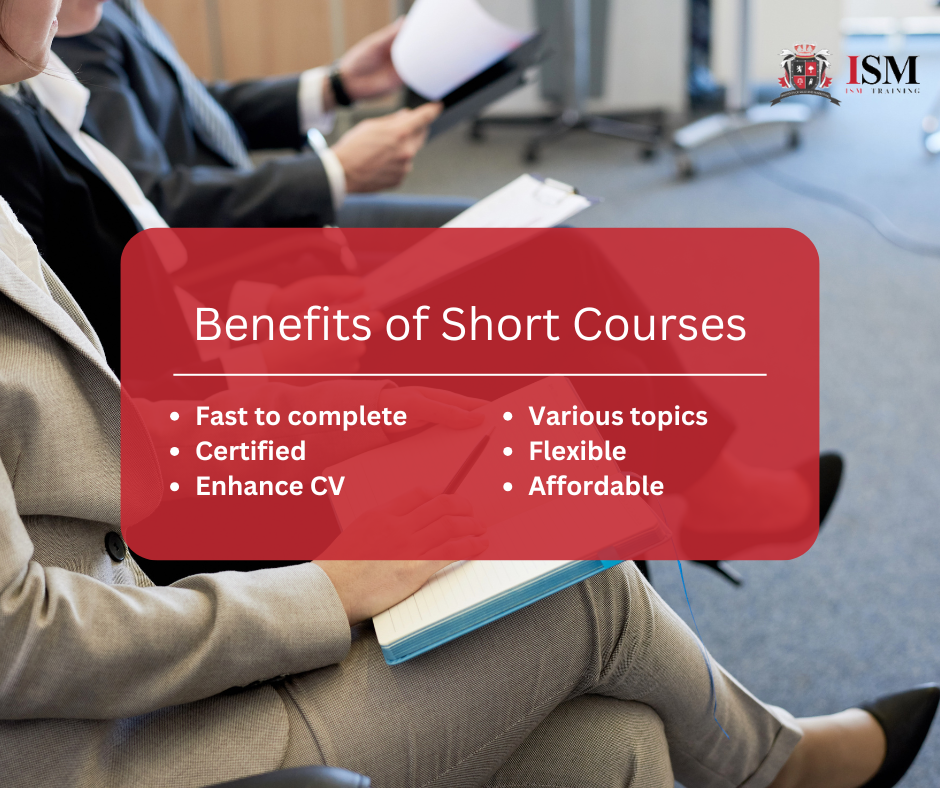
However, correctly run short courses come with many benefits, including:
- They are fast to complete
- You receive a certificate on completion
- They enhance your CV
- They improve your employability
- You have a wide range of topics to choose from
- Part-time study options exist
- You can fit flexible learning in your busy schedule
- They are affordable
What successful short courses do differently
The good news is that short courses can work very well.
The most effective courses are:
- focused,
- practical,
- designed around real needs.
In other words, successful short courses are built with care.
At ISM Training, that is exactly how we approach learning. We know that no two teams are the same.
That is why we customise our courses to match the client, the business goal, and the people in the room. We also bring deep experience of the region, which helps us create training that feels relevant, useful, and realistic.
Just as important, we believe training should be engaging. Learning should not feel dry or outdated. It should feel fresh, practical, and easy to apply. This is why our courses are full of fun learning activities.
Final thoughts
Short courses are not inherently ineffective. In fact, when they are done well, they can deliver real value in a short space of time.
The problem is not the format. The problem is poor design.
When a short course is tailored, focused, and supported, it can make a real difference. That is what businesses should look for. Not just a shorter course, but a smarter one.
Ready to stop box-ticking and start building skills? Browse our tailored courses to find the perfect fit for your team.